We’ve Participated Before. Should We Join Another Action Collaborative?
One question we hear from past Step Up Together participants is:“We already did an Action Collaborative. Is there any reason to do another one?”
In most cases, the answer isyes.
The goal of Step Up Together has never been to conduct a single drill and call it done. Like any aspect of emergency preparedness, transfer readiness improves through ongoing practice, relationship-building, and continuous learning. Each Action Collaborative offers opportunities to strengthen different parts of your system and deepen the work you started previously.
Every Transfer Scenario Is Different
A team that completed an intrapartum transfer drill has not necessarily practiced the same skills needed for a postpartum hemorrhage or a newborn emergency.
Transfer processes often vary depending on:
Whether the patient is pregnant, postpartum, or a newborn
Which clinical teams become involved
What information needs to be communicated
How transportation and escalation pathways work
Participating in a different drill scenario allows teams to identify new strengths, uncover different vulnerabilities, and build readiness across a broader range of emergencies.
Work With Different Partners
Many communities have more than one referral relationship.
A hospital may receive transfers from:
Multiple home birth midwives
One or more birth centers
Different EMS agencies
Likewise, community midwives may transfer to more than one hospital depending on geography, insurance networks, patient preferences, or clinical circumstances.
A second Action Collaborative creates an opportunity to strengthen relationships with additional partners and ensure that transfer processes work consistently across the entire community, not just between a single pair of organizations.
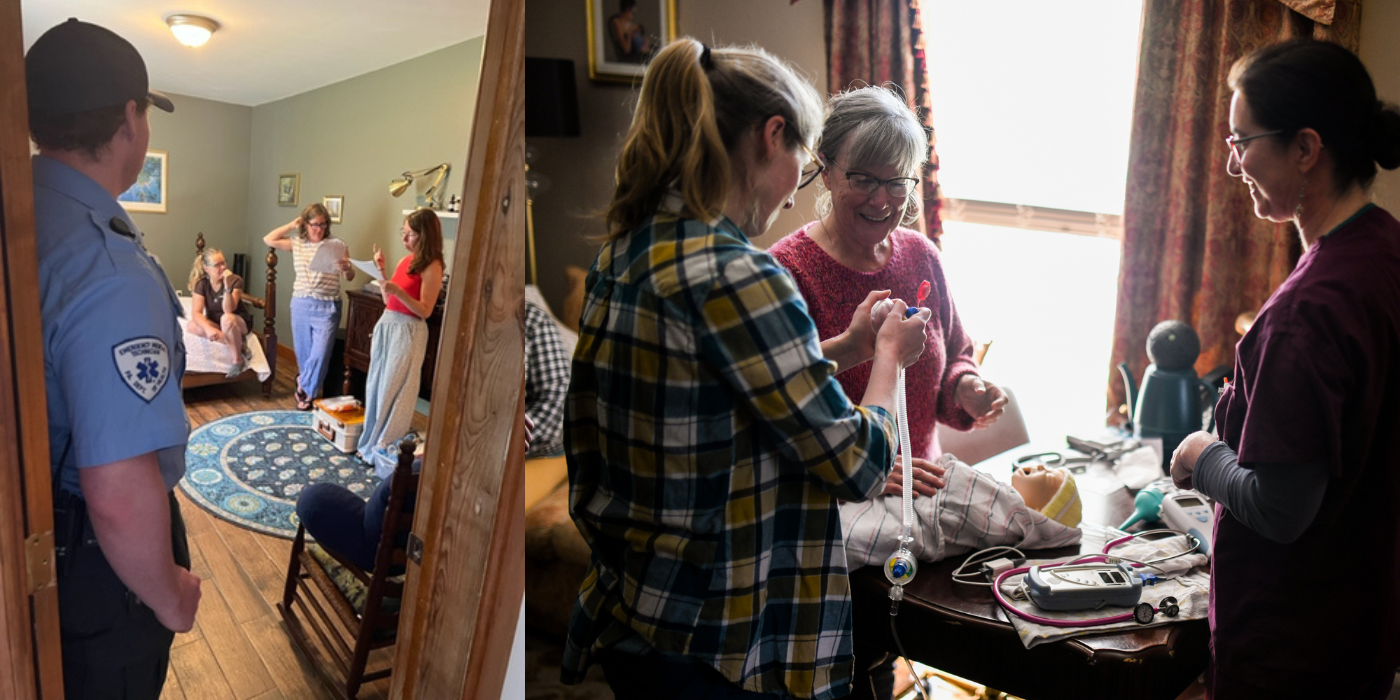
Cocoon Wellness and Birth Center in rural upstate New York has participated in multiple Action Collaboratives. Their first drill engaged their local EMS (left), and they later worked with the regional neonatal transport team from the referral hospital (right).
Go Beyond the First Drill
Not every team is able to complete a full high-fidelity transfer drill during their first Action Collaborative.
Some teams begin with:
A tabletop exercise
A modified simulation
A partial transfer drill
A focused planning process
These ways ofright-sizing your drillare valuable starting points. However, many participants find that their first experience reveals how much more is possible.
Returning for another Action Collaborative can help teams progress from planning to practice, increase realism, involve additional stakeholders, and test more complex aspects of the transfer process.
Emergency Preparedness Is Not a One-Time Event
Hospitals conduct regular fire drills. EMS teams routinely practice emergency response. Birth centers complete quarterly drills as part of accreditation requirements.
Transfer readiness deserves the same mindset.
Staff turnover occurs. New partners enter the system. Policies change. Equipment changes. Communication pathways evolve.
Regular practice helps teams maintain readiness and ensures that improvements made after one drill do not fade over time.
Tap Into Structure
While all of ourDrill Kitsremain available for teams to use independently, many participants tell us that the structure of the Action Collaborative helps them accomplish something that might otherwise stay on the “someday” list.
The collaborative provides:
Clear timelines and milestones
Technical assistance from Step Up Together Faculty
Peer learning from other participating teams
Accountability that helps move planning into action
Coordinating a transfer drill remains a significant undertaking, even if you’ve done it before. The Action Collaborative provides a proven framework for bringing the right people together and seeing the process through.
Learn From the Community of Practice
One of the most valuable aspects of returning participants is the opportunity to learn alongside a new cohort.
Every team approaches transfer readiness from a different perspective. Rural hospitals, urban birth centers, EMS agencies, health systems, and home birth practices all encounter unique challenges and develop innovative solutions.
Participants consistently report that they learn as much from one another as they do from the drill itself.
When you join another Action Collaborative, you are not simply repeating an exercise. You are becoming part of an expanding national community of practice dedicated to strengthening collaboration, improving safety, and building more integrated systems of maternity care.
The Bottom Line
If you’ve participated before, consider joining again if you want to:
Practice a different emergency scenario
Strengthen relationships with additional transfer partners
Complete a more advanced or higher-fidelity drill
Maintain and improve transfer readiness over time
Benefit from the structure and support of the collaborative
Learn from a new cohort of peers across the country
Transfer readiness is not a destination. It’s an ongoing practice. And every drill is an opportunity to take the next step together.
Applications for the Fall/Winter cycle are due August 17!